Video
Consolidation of Law, Legal Order, and the Question of Constitutionalizing Processes in the Achaemenid Empire
Abstract
The Old Persian inscriptions of Darius I deal with a range of legal, particularly constitutional questions. The famous grave inscription from Naqsh-i Rustam (DNb) constitutes the conceptional center of a thematical text corpus, exemplified in specific details and different legal aspects in other inscriptions of Darius I. However, it is a core question if these royal inscriptions had only a function of royal representation (and for the presentation of royal ideology) or if they also claimed to consolidate (royal or imperial) law. If so, the royal epigraphic corpus of this particular Great King seems to illustrate an overarching legal concept shaped by its textual and thematic interrelations. Consequently, the Achaemenid royal inscriptions, and in particular the Darius Naqsh-i Rustam b text, thus provide a draft for an imperial legal order that fundamentally defines the Great Kingship, both in relation to the subjects and for the position of the Great King himself. The DNb inscription can thus be understood as a manifesto which enshrines in a general and fundamental way the conditions of royal rule in the Achaemenid Empire. With this in mind, this lecture will present the argument for constitutionalizing processes in this multiethnic and multicultural polity.
Citation
Klinkott, Hilmar. "Consolidation of Law, Legal Order, and the Question of Constitutionalizing Processes in the Achaemenid Empire," Pourdavoud Lecture Series (April 17, 2024).
About the Speaker
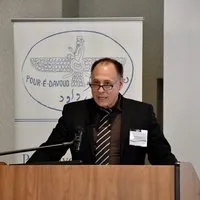
Hilmar Klinkott
University of Kiel
Hilmar Klinkott is Professor of Ancient History and History of the Near East at the Institute for Classical Studies/Department of Ancient History at the University of Kiel.
He studied Ancient History, Classical Archaeology, and Latin at the Ruprecht Carls University Heidelberg, earning his MA in 1997. He continued his studies at the University of Tübingen, earning his PhD in 2002. His thesis, Der Satrap: Ein achaimenidischer Amtsträger und seine Handlungsspielräume (Verlag Antike), was published in 2005.
After his habilitation in Ancient History at the University of Tübingen, he became Akademischer Rat in the Seminar für Alte Geschichte und Epigraphik at the Ruprecht Karls-Universität Heidelberg in 2012 and a member of the Heidelberg excellence cluster “Asia and Europe in a Global Context” in 2013. In the same year, he changed his habilitation to the University of Heidelberg (“Umhabilitierung”).
After Deputy Professorships in Hamburg (for Professor Christoph Schäfer, 2009–2010), Mannheim (for Professor Christian Mann, 2014/15) and Mainz (Professor Marietta Horster, 2016), he was appointed Full Professor at the Institut für Klassische Altertumskunde of the Christian Albrechts University. Now at the University of Kiel, Professor Klinkott continues to focus on the history of the ancient Near East and the Achaemenid empire.