Video
How to Govern an Empire? The Inscriptions of Darius I As a Constitutional Program
Abstract
The Old Persian inscriptions of Darius I refer to a range of legal – particularly constitutional – questions. The famous tomb inscription from Naqsh-e Rustam (DNb), it is argued, represents a conceptional mission statement for Darius’ vision of governance. The text of DNb is amplified and echoed in other inscriptions of the Great King, the sum of which is akin to a “constitutional” declaration. The paper posits that this “constitutional corpus” and the resulting legal framework it expounds bring to light two major notions: first, the “constitution” of the Achaemenid empire is much more than a pure adaptation or transition of former Mesopotamian kingships (for example by Assyrian or Babylonian traditions); and second, the constitutional framework of the royal texts indirectly reflects the debates taking place among the empire’s leading élites, which were likely conducted behind the scenes. Against this background, it is time to reconsider the statement of Fritz Gschnitzer, namely, that a constitutional discussion, as reported by Herodotus for Darius’ claim to power, would be a strictly “Greek” element. Finally, the transmission of an Achaemenid constitutional concept might have provided an impetus for the ways in which the Hellenistic monarchies organized the administration and government of their multiethnic and multicultural empires (“Großreiche”).
Citation
Klinkott, Hilmar. "How to Govern an Empire? The Inscriptions of Darius I As a Constitutional Program." Pourdavoud Center: The World of Ancient Iran and the West (May 19, 2022).
About the Speaker
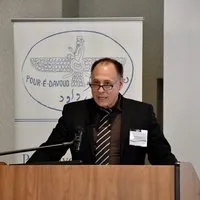
Hilmar Klinkott
University of Kiel
Hilmar Klinkott is Professor of Ancient History and History of the Near East at the Institute for Classical Studies/Department of Ancient History at the University of Kiel.
He studied Ancient History, Classical Archaeology, and Latin at the Ruprecht Carls University Heidelberg, earning his MA in 1997. He continued his studies at the University of Tübingen, earning his PhD in 2002. His thesis, Der Satrap: Ein achaimenidischer Amtsträger und seine Handlungsspielräume (Verlag Antike), was published in 2005.
After his habilitation in Ancient History at the University of Tübingen, he became Akademischer Rat in the Seminar für Alte Geschichte und Epigraphik at the Ruprecht Karls-Universität Heidelberg in 2012 and a member of the Heidelberg excellence cluster “Asia and Europe in a Global Context” in 2013. In the same year, he changed his habilitation to the University of Heidelberg (“Umhabilitierung”).
After Deputy Professorships in Hamburg (for Professor Christoph Schäfer, 2009–2010), Mannheim (for Professor Christian Mann, 2014/15) and Mainz (Professor Marietta Horster, 2016), he was appointed Full Professor at the Institut für Klassische Altertumskunde of the Christian Albrechts University. Now at the University of Kiel, Professor Klinkott continues to focus on the history of the ancient Near East and the Achaemenid empire.